The Art of Living - Israel 2025
- Geoffrey Clarfield
- Nov 21, 2025
- 6 min read

I once used to live and work in Israel. Since that time I have come back for regular visits. Of course, close family and friends draw me back. But I also come just to watch and absorb what is going on around me for Israel is always changing and yet, I would like to think at some level it does not.
Year to year, it is almost physically unrecognizable. What was once an open field, plain or hill, is suddenly covered with houses, apartments, shopping malls, schools, and community centers. This should come as no surprise for unlike Europe and Canada the birth rate here is going up, not down.
Then there is a national commitment to build modern up to date trains. In 1971 I took the train from Tel Aviv to Jerusalem. It was slow and noisy like out of a 19th century part of rural eastern Europe. Just before you enter Jerusalem you could look down into the valleys and still see the remains of Turkish and British lookout posts that once guarded the road and rail from the coast to Jerusalem.
And then just before you arrive at the station you would see the Arab village of Battir, whose name is a slight variation of the word Beitar, one of the villages that supported the Maccabees in their revolt against their Hellenistic Syrian oppressors more than two thousand years ago.
The Syrians are still at it, and modern Israelis must fight them to protect the integrity and safety of the state as well as the threatened minorities of Syria such as the Druze and the Christians in that failed state. That is just one way that things do not change.
What is different is that none of the founders of the state ever thought that Israel would become the protector of its hostile neighbors persecuted minorities. Sadly, such is the nature of modern Jihad.
Today the train is well organized, clean, fast and efficient and when hurtling towards Tel Aviv from Jerusalem on a Friday morning one takes a childish glee in seeing how fast and easy it is compared to the jammed traffic that you can see on the highway not far from the train tracks.
I looked and listened to the people sitting beside me. Most of them had earphones on and were lost in their own audio world. However two women a little older than me were having an animated conversation comparing recipes. They seemed to be long-term friends or relatives travelling together.
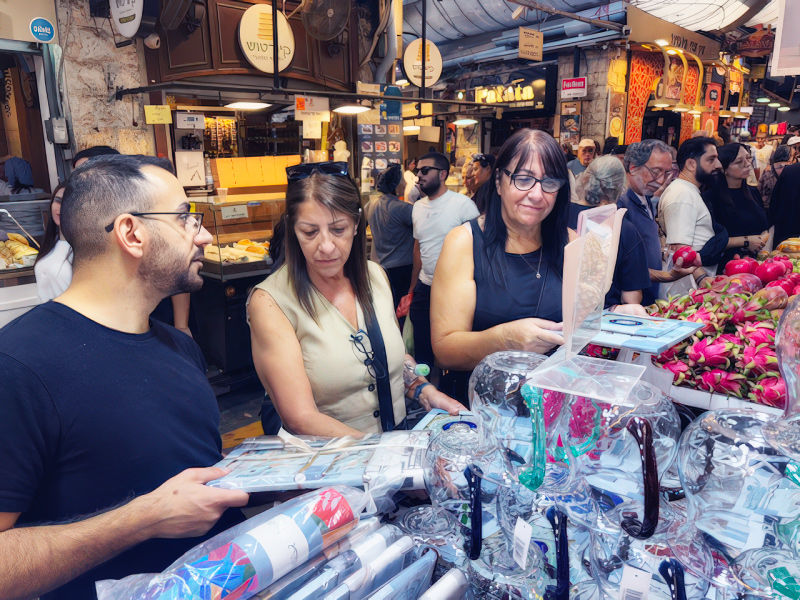
If you tour Israel, alone or in a group, in between visiting Israel’s archaeological wonders you will eat at many hotels and restaurants and come to realize that although there are four main religions here, Judaism, Christianity, Islam, and Bahai the fifth religion is food. Food tastes better here and people talk about it constantly.
And then there is the street. I am staying at an Air B and B near Dizengoff street in central Tel Aviv, a street filled with restaurants and pubs of all kinds where young people in the peak of fitness, both male and female, parade their fine figures wearing versions of French and Italian clothes which always have an unconscious Israeli twist; more colorful, more dramatic, more revealing perhaps, especially the young women.
And then there is the famous abruptness and what westerners would call impolite behavior on the streets and roads. This gives Israel and Israelis a bad name for this is their behavior at its worse. Israel still has a long way to go towards a culture of civic virtue. Israelis under the age of fifty do not do the wild in the streets routine as it used to be practiced here decades past.
But that is the price of progress for although some call Israel the startup nation whose entrepreneurs do not fear risk, I call contemporary Israel Singapore with Swagger and when you finally meet Israelis, outsiders often find their pride borders on arrogance. There is a fine line between the two.
And then you can watch and look at middle-aged couples, older people, and the frail. Their faces are still open for Israelis live with the hope of peace. They are looking at the world around them although one can often see the care written into the lines of their faces, for every man and woman serves in the military in some capacity and men then give at least a month each year in reserve service until their early forties.
I have always thought that if I were a billionaire Jewish donor (and there are far less around than one would think) I would create a fund which matches the army pay of every acting soldier until they retire from the reserve.
I would also give every soldier that finishes her or his service a 100,000 dollar credit towards purchase of a property, which in this country often happens after marriage, when parents on both sides of the relationship give or commit a large sum to help the young couple buy a place. And sadly there is still a housing crisis although you see building cranes in every part of every city in Israel.
If you are a tourist and you want to get a second hand look at what makes Israelis tick just go to the beach. Even though Judea and Samaria are the heartland of Biblical Israel, the pragmatics of Jewish return to the land of Israel in the modern era has focused on the coast and thus Israelis are mostly a coastal people.
Although you can see individuals, often young men and women at the beach, Israeli beaches are filled with groups of people. Who are they? They are families and friends. They set up their chairs, tents and umbrellas, bring their food and drinks, and watch their children build sandcastles and run up against the waves.
Some beaches try and limit the noise from ghetto blasters, but this does not always work. Israelis play a kind of beach tennis called Matkot where they use small rackets to knock a tiny ball back and forth.
In the 1950s and early 1960s after Prime Minister David Ben Gurion started standing on his head as part of a morning Yoga routine, and so you could see retired men and women doing the same. That is no longer the case as there are Yoga studios everywhere you go in Israel.
The beach is where you can see Israeli families at a distance and everyone focuses on the children.
Although Israel has its fair number of broken and feuding families on the whole family is everything here. You are born into a family and often an extended one. Your parents, work, take care of you and serve in the military. Your grandparents are often around. You visit them and they visit you regularly. And they do not have to call before they come. That is understood in advance.
And then there is Sabbath dinner when extended family and friends are invited as they will invite you. Then there are the major holidays which in Judaism are family holidays although for the religious they include synagogue services.
And then there is the National Health System which now works on the Swedish tiered model. So let me be clear for a nation that was once told that it was a disease to be exterminated Israelis are confident that if they are hurt or ill, they will not go bankrupt from sudden medical and hospital expenses as so often happens in the United States.
Then you bond with the kids you go to school with. Then with the people in your army unit. And then with those with whom you go into higher education where so many young Israelis meet and get married. To put it mildly, Israelis are networked and this is the open secret of Israeli resilience. It is based on the traditional Jewish values of faith, family, and solidarity, at so many different levels.
Yes, political life is still loud, noisy, disputatious, argumentative, and often venal. Would that it would be otherwise, but Israeli does not live in a vacuum. These are Mediterranean features and here the country is temperamentally divided between Zorbas and the English teacher, if you are old enough to remember the film. Ethnicity aside, the Zorbas outnumber the English teachers.
What most visitors do not see is that in every house, in every apartment or skyscraper there are these families, who love children, take care of their elders and whose houses are open, hustling, bustling intergenerational hubs of gregariousness. And do not forget that although Israelis are distinctively Israeli, they are also well travelled and interested in the wider world.
Despite the trauma of this latest war (for I would re brand October 7th as the War Against Seven Enemies for seven military entities tried to invade and destroy the country-the faces of the fallen often grace the walls of train stations-it is touching), I have family on both sides and unlike most tourists I have the privilege of seeing Israelis as they are and enjoying this young country with its old time family values.
Yes, the economy is growing. And there are larger and larger apartment towers being built everywhere, but underneath all this swagger and entrepreneurial creativity is love of family and care for the elderly.
When Europe and North America stop beating up on Israel they can come here and learn something basic about the art of living. May that day come soon.


